Flight Training

Flight Training in London, Ontario

Build knowledge, confidence and sound decision-making through structured ground and flight instruction.

Speak With AdmissionsExplore Programs

Transport Canada Flight Training Pathways

Requirements, minimum hours and training milestones

ProgramKey eligibilityMinimum trainingCompletion requirements
Recreational Pilot Permit — AeroplaneMinimum age 16 at issuance; Category 4 medical or higher25 flight hours minimum, including at least 15 dual and 5 solo; ground-school and knowledge preparationRequired written examination and flight test; pre-solo requirements must be completed before solo flight
Private Pilot Licence — AeroplaneMinimum age 17 at issuance; Category 3 medical or higher40 hours ground school and 45 flight hours minimum, including dual, solo, cross-country and instrument trainingPPAER written examination and private-pilot flight test
Night Rating — AeroplaneHold a Canadian aeroplane pilot licence20 hours pilot training: 10 hours night and 10 hours instrument training, with required dual, solo, cross-country, takeoff and landing experienceInstructor recommendation after the required experience and proficiency are completed
VFR Over-the-Top RatingHold a Canadian aeroplane pilot licence15 hours dual instrument training, including the applicable instrument and navigation exercises; permitted simulator credit is limitedInstructor recommendation after meeting the experience and skill standard
Instrument Rating — AeroplaneHold the applicable pilot licence and medical; meet cross-country PIC prerequisites50 hours cross-country PIC and 40 hours instrument time, subject to permitted simulator credit and required dual instructionINRAT examination and instrument-rating flight test

Programme planning note: Licence and rating requirements are set by Transport Canada. Confirm current eligibility, experience, examination and flight-test requirements with CPA before enrolling.

Recreational Pilot Permit (RPP)

25 hours minimumAge 16Category 4 medical

A focused pathway for pilots who want to fly eligible single-engine aeroplanes recreationally in Canada. CPA training covers aircraft control, circuits, emergency procedures, navigation fundamentals, radio work and flight-test preparation.

  • Admission and medical-document review
  • Ground knowledge and written-exam preparation
  • Dual instruction and supervised solo flying
  • Progress checks and flight-test recommendation when ready

Private Pilot Licence (PPL)

45 hours minimum40-hour ground schoolAge 17

The PPL is the principal foundation for recreational aviation and future advanced ratings. Training includes air exercises, circuits, navigation, instrument appreciation, cross-country operations, decision-making and flight-test preparation.

  • At least 17 hours dual instruction, including required cross-country and instrument experience
  • At least 12 hours solo, including required solo cross-country experience
  • Transport Canada written examination preparation
  • Flight-test readiness based on demonstrated proficiency—not hours alone

Night Rating

10 hours night10 hours instrument

Extend your operating capability beyond daylight while developing stronger instrument reference, situational awareness and night decision-making.

  • Dual night instruction and night cross-country
  • Required solo night takeoffs, circuits and landings
  • Instrument training with permitted simulator credit
  • No separate Transport Canada written examination or flight test is normally required

VFR Over-the-Top Rating

15 hours dual instrument

Build the instrument-reference and navigation skills required to operate VFR above a cloud layer when legal conditions and forecasts support the flight.

  • Basic instrument flying and recovery skills
  • Radio navigation and practical route planning
  • Weather interpretation and legal VFR OTT limitations
  • Instructor recommendation after the standard is met

Instrument Rating

50 hours cross-country PIC40 hours instrument

Develop the procedural discipline and instrument-flight skills required for IFR operations, including departures, en route procedures, holds, approaches, missed approaches and abnormal situations.

  • Eligibility and experience review before programme planning
  • Ground preparation for the INRAT examination
  • Aircraft and approved simulator training as applicable
  • Mock flight test and recommendation when standards are met
Transparent Training Rates

Build a realistic training budget

CPA uses clear hourly rates so students can see how a flight-training estimate is built. These approximations are not fixed-price guarantees; actual completion time depends on proficiency, lesson frequency, weather, aircraft availability and Transport Canada standards.

C172 aircraft$254.25per flight hour
Flight instructor$101.70per instructional hour
Aircraft + instructor$355.95per dual flight hour

Approximations exclude ground school, briefings beyond quoted flight time, simulator charges, medical examinations, Transport Canada fees, flight-test fees, books/equipment, fuel surcharges if applicable and HST. Final enrolment documents will identify current inclusions and payment policies.

Programme Brochures

Choose your flight-training pathway

Each programme summary combines regulatory minimums, a transparent planning scenario and the outcome students are working toward.

START FLYING

Recreational Pilot Permit

Focused recreational flying in Canada.

Approximate: $8,390.25

Planning example: 20 dual hours and 5 solo hours.

  • 25 flight hours minimum
  • Age 16 at issuance
  • Category 4 medical or higher
  • Written examination and flight test

* Transport Canada minimum times only. Actual flight times may vary by student.

Request the RPP training plan →

FOUNDATIONAL LICENCE

Private Pilot Licence

The foundation for personal flying and advanced ratings.

Approximate: $14,492.25

Planning example: 30 dual hours and 15 solo hours.

  • 45 flight hours minimum
  • 40-hour ground school
  • Age 17 and Category 3 medical
  • PPAER examination and flight test

* Transport Canada minimum times only. Actual flight times may vary by student.

Request the PPL training plan →

CAREER PATHWAY

Commercial Pilot Licence

Professional aeroplane pilot training.

Core training: $20,085.75

Approximate: 35 dual and 30 solo commercial-training hours. Additional hour building to the 200-hour total-time requirement is separate.

  • Hold a PPL and Category 1 medical
  • 80-hour commercial ground school
  • 200 hours total flight time
  • CPAER examination and flight test

* Transport Canada minimum times only. Actual flight times may vary by student.

Request the CPL training plan →

ADVANCED RATING

Night Rating

Develop safe night and instrument-reference skills.

Up to $6,610.50

Aircraft-based approximate: 15 dual and 5 solo hours. Permitted simulator use may change the aircraft component.

  • 10 hours night training
  • 10 hours instrument training
  • Dual night cross-country
  • Required solo circuits and landings

* Transport Canada minimum times only. Actual flight times may vary by student.

Request the Night Rating plan →

ADVANCED RATING

VFR Over-the-Top

Operate VFR above cloud when conditions permit.

Up to $5,339.25

Aircraft-only approximate for 15 dual hours; approved simulator credit may reduce aircraft time.

  • 15 hours dual instrument training
  • Navigation and instrument exercises
  • Weather and legal limitations
  • Instructor recommendation

* Transport Canada minimum times only. Actual flight times may vary by student.

Request the VFR OTT plan →

IFR QUALIFICATION

Instrument Rating

Prepare for instrument flight rules operations.

$7,119–$14,238 aircraft approximate

Illustrates 20–40 dual aircraft hours. Prior instrument credit and approved simulator time materially affect the final estimate.

  • 50 hours cross-country PIC prerequisite
  • 40 hours instrument time
  • INRAT examination
  • Instrument-rating flight test

* Transport Canada minimum times only. Actual flight times may vary by student.

Request the Instrument Rating plan →

TOUR OUR FACILITY

Step inside Canadian Pilot Academy

Take a quick tour of our London International Airport training facility and see where your aviation journey begins.

Train at CYXU-London

Professional training at London International Airport

CPA’s main base is at London International Airport, a controlled airport. Students gain regular experience communicating with air traffic control, using professional radio procedures, operating on paved runways and sharing airspace with varied traffic. The airport also has instrument approach infrastructure that supports advanced training.

  • Real-world controlled-airspace communication from early in training
  • Access to nearby practice areas and useful cross-country destinations
  • Operational exposure that supports night, instrument and commercial progression
  • Training from CPA’s certified main base at 2475 Aviation Lane

Applications are currently being accepted.

Contact Admissions for programme availability, medical guidance, required documents and the next available start pathway.

Start Your Application

Flight Training Instruction

Experienced flight instructors on staff

Canadian Pilot Academy’s flight-training programmes are delivered by qualified, experienced flight instructors who provide structured briefings, practical coaching, progress monitoring and flight-test preparation. Instructor assignment is based on programme needs, scheduling and student progression.

Flight training and RPAS training are separate programmes. Drone certification, RPAS flight reviews and enterprise drone services are presented independently through the Drone Pilot Academy and Enterprise Drone Solutions pages.

How the training process works

1. Eligibility review

We review age, medical status, prior experience and programme goals before recommending a pathway.

2. Training plan

Ground school, flight lessons, study milestones and estimated scheduling are organized around the selected permit, licence or rating.

3. Progress checks

Instructor records and stage checks identify strengths, training gaps and readiness for solo, examinations or flight testing.

4. Recommendation

Students are recommended for a flight test or rating only after meeting the applicable knowledge, experience and proficiency standards.

TRANSPORT CANADA CERTIFIED

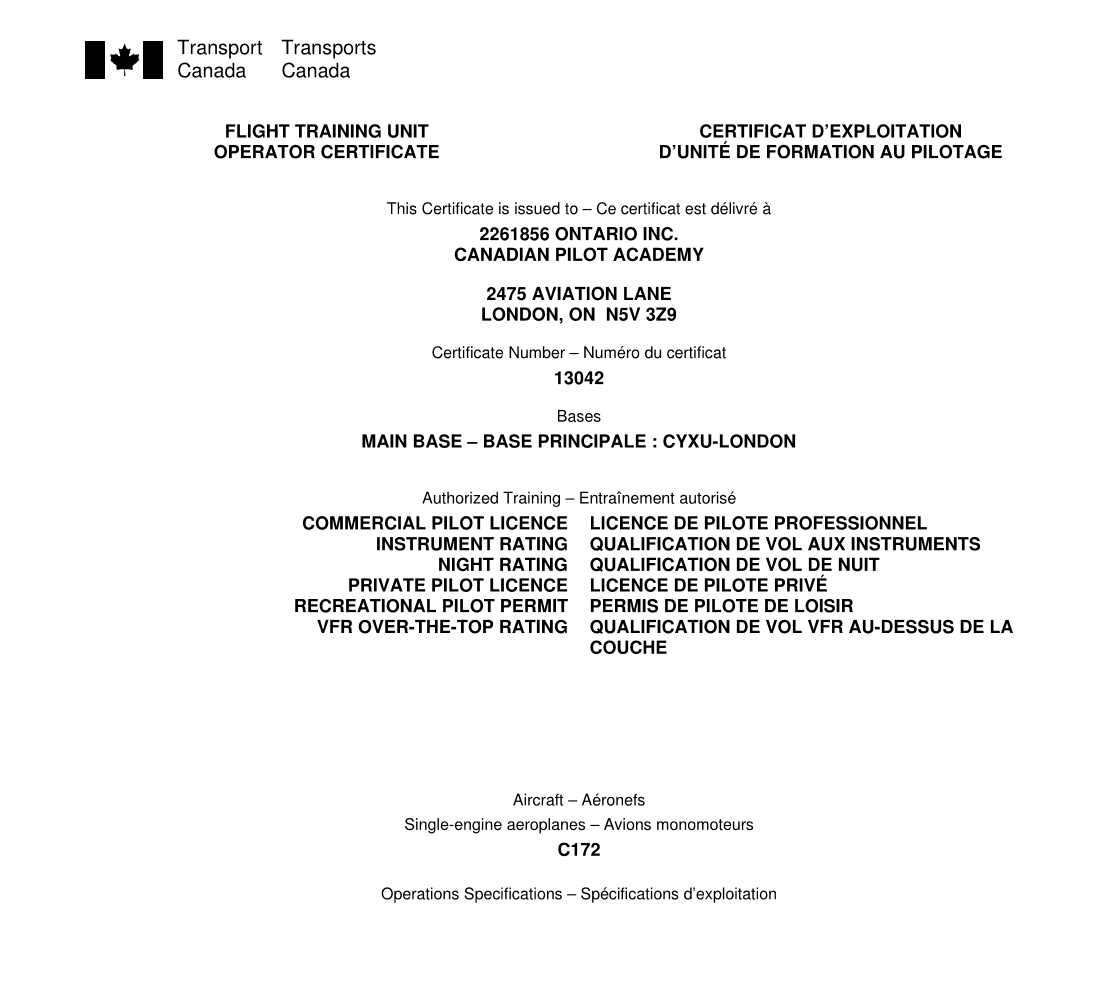
Canadian Pilot Academy Flight Training Unit

Canadian Pilot Academy operates under Transport Canada Flight Training Unit certificate #13042 from our certified main base at CYXU–London International Airport.

Our authorized aeroplane training privileges on Cessna 172 aircraft include:

  • Recreational Pilot Permit
  • Private Pilot Licence
  • Commercial Pilot Licence
  • Night Rating
  • VFR Over-the-Top Rating
  • Instrument Rating

Transport Canada Flight Training Unit certificate #13042 issued to Canadian Pilot Academy

Flight Training FAQ

Frequently asked questions about learning to fly in Canada

Detailed answers for prospective RPP, PPL, CPL, Night, VFR Over-the-Top and Instrument Rating students training in London, Ontario.

What is the difference between an RPP and a PPL?

A Recreational Pilot Permit is intended for more limited recreational flying and carries narrower privileges. A Private Pilot Licence provides broader privileges and is normally the foundation for advanced ratings and commercial training. CPA can review your long-term objective before you choose.

How many hours does a Private Pilot Licence take?

Transport Canada sets a 45-hour minimum for the aeroplane PPL. Many students require additional time to reach flight-test proficiency. Lesson frequency, preparation, weather and individual progress materially affect the final total.

How many hours does a Recreational Pilot Permit take?

The aeroplane RPP has a 25-hour regulatory minimum. This is not a guaranteed completion time; the permit is issued only after the applicable knowledge, experience and proficiency requirements are satisfied.

How long does flight training usually take?

Training duration depends on how often you fly, weather, aircraft and instructor availability, study progress and proficiency. Students who train consistently usually progress more efficiently than students with long gaps between lessons.

How often should I schedule flying lessons?

Two or more lessons per week is often helpful for continuity, but the right schedule depends on your availability and learning pace. Your instructor can recommend a realistic frequency and adjust it as training progresses.

Do I need an aviation medical before starting?

You may begin introductory training before every licensing step is complete, but the appropriate medical is required for key milestones and eventual permit or licence issuance. Starting the medical process early helps avoid preventable delays.

What medical category do I need?

The required category depends on the permit or licence. The RPP may use a Category 4 or higher, the PPL generally requires Category 3 or higher, and the CPL requires a Category 1 medical. Confirm current eligibility with Transport Canada and a Civil Aviation Medical Examiner.

What does flight school cost in London, Ontario?

Total cost depends on aircraft time, instructor time, ground instruction, equipment, medical and examination costs, taxes and the hours required to reach proficiency. CPA publishes hourly rates and approximate planning figures rather than promising a fixed completion price.

Are the programme prices fixed packages?

No. They are approximate budgeting scenarios based on stated rates and assumed hours. Transport Canada minimum hours do not guarantee flight-test readiness, and actual student totals vary.

What is included in dual flight time?

Dual flight time is flown with an instructor. At the current listed rates, the C172 aircraft and instructor total $355.95 per dual flight hour before applicable taxes and other stated charges. Pre- and post-flight briefing requirements may be billed separately under current school policies.

What is solo flight training?

Solo flight is conducted without an instructor aboard after the student has met regulatory and school authorization requirements. Solo exercises are assigned and supervised within the approved training programme.

Can previous flight experience be credited?

Documented previous experience may be reviewed against applicable Transport Canada credit provisions and CPA’s assessment of currency and proficiency. Bring complete logbooks and training records for review.

Where does CPA conduct flight training?

Canadian Pilot Academy operates from its main base at London International Airport, CYXU, at 2475 Aviation Lane in London, Ontario.

Is training at a controlled airport beneficial?

It provides routine exposure to air traffic control, radio procedures, paved-runway operations and varied traffic. Students still require appropriate training-area and cross-country experience as their programme progresses.

Can I train part-time while working or studying?

Yes, subject to scheduling and availability. A consistent plan is strongly recommended because lengthy interruptions can increase review time and overall training hours.

When can a student fly solo?

Solo authorization occurs only after the student satisfies applicable age, medical, knowledge and proficiency requirements and the supervising instructor determines that the student is ready for the planned exercise and conditions.

What exams are required?

The required Transport Canada written examination depends on the permit, licence or rating. Flight tests or qualifying flights also apply where required. CPA’s programme page identifies the principal examination associated with each pathway.

Does completing ground school guarantee a licence?

No. Ground school is one component. Applicants must independently satisfy all applicable medical, knowledge, experience, skill, examination and flight-test requirements.

Can I build hours toward a Commercial Pilot Licence?

Qualified PPL holders may build eligible experience toward commercial requirements, but flights should be planned and logged carefully. CPA can help separate formal commercial training from additional hour building.

Can I complete Night or Instrument training at CPA?

CPA’s FTU certificate authorizes Night Rating, VFR Over-the-Top and Instrument Rating training on C172 aircraft, subject to instructor, aircraft, equipment, weather and scheduling availability.

What should I bring to an admissions consultation?

Bring your aviation goal, availability, prior licences or permits, medical status and any existing logbooks or training records. This allows CPA to recommend a responsible pathway and approximate budget.

Is Canadian Pilot Academy accepting students?

CPA is currently accepting enquiries for flight and RPAS training. Admission and start dates depend on programme suitability, documentation, instructor and aircraft availability.

Not sure where to begin?

Book a complimentary one-hour consultation with Canadian Pilot Academy to discuss your goals, eligibility, schedule and the best starting point.

Book a Free Consultation

Now accepting flight-training and RPAS students

Speak with CPA about eligibility, scheduling, current availability and the programme that fits your aviation goals.

Canadian Pilot Academy does not offer programs for international students.
International applicants may search the Government of Canada Designated Learning Institutions list and the Ontario career-college registry for eligible institutions.
Canadian Pilot Academy’s current programs are not eligible for T2202 tuition tax certificates.

Contact Admissions